Compound miter calculator
For a box with sides that lean outward, enter the number of sides and their tilt from vertical to get the miter and bevel for each corner.
Enter your measurements
- Table-saw miter gauge (reads 90° at square)
- 75.5 degrees
- Top & bottom edge bevel
- 15 degrees
- Side board width (up the slope)
- 12-7/16 in
- Bottom edge of each side (outside)
- 16 in
- Top edge of each side (outside)
- 22-7/16 in
bevel = asin(cos 15° × sin(180° ÷ 4)) = 43.1°
miter = atan(sin 15° × tan(180° ÷ 4)) = 14.5°
Side board width = 12 in ÷ cos 15° = 12-7/16 in
Top edge = 16 in + 2 × 12 in × tan 15° × tan(180° ÷ 4) = 22-7/16 in
- Angles are measured from square, the way most miter saws are marked: 0° miter and 0° bevel is a plain crosscut.
- Side boards are cut as trapezoids: the bottom edge is the base length and the top edge is longer, both measured on the outside face from long point to long point.
Quick answers for common sizes
| Example | Answer |
|---|---|
| Compound miter angles for a 4-sided planter with 15° sides | 43.1 degrees |
Settings by side tilt (same number of sides)
| Side tilt from vertical | Blade bevel (tilt) | Miter (table) angle |
|---|---|---|
| 0° | 45 degrees | 0 degrees |
| 5° | 44.8 degrees | 5 degrees |
| 10° | 44.1 degrees | 9.9 degrees |
| 15° | 43.1 degrees | 14.5 degrees |
| 20° | 41.6 degrees | 18.9 degrees |
| 30° | 37.8 degrees | 26.6 degrees |
| 45° | 30 degrees | 35.3 degrees |
| 60° | 20.7 degrees | 40.9 degrees |
Planters, hoppers and tapered bins all have sides that lean outward, so their corner joints need both a miter and a bevel. Add the box height and base size to also get the width of each side board and the length of its top and bottom edges. New to this? Words explained.
The formulas
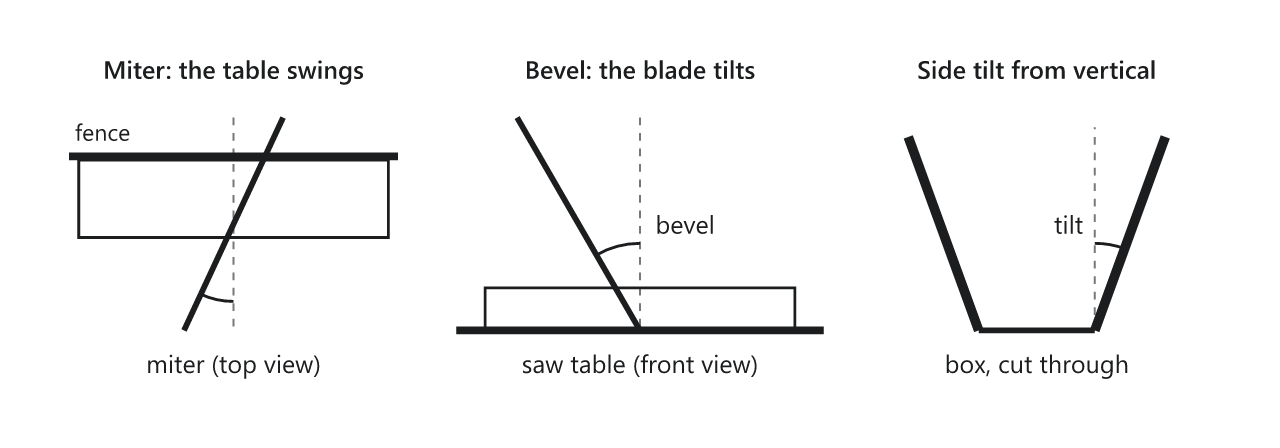
With the board lying face-down on the saw table and the cut running across its width, the two settings depend only on the number of sides (n) and the tilt of the sides from vertical (t):
blade bevel = asin( cos t × sin(180° ÷ n) )
miter angle = atan( sin t × tan(180° ÷ n) )
top & bottom edges: rip at t so they sit level
Check the extremes: with straight sides (t = 0) a square box needs a 45° bevel and no miter; laid flat (t = 90°) it becomes a picture frame with a 45° miter and no bevel.
| Four-sided box, side tilt | Blade bevel | Miter |
|---|---|---|
| 5° | 44.8° | 5° |
| 10° | 44.1° | 9.9° |
| 15° | 43.1° | 14.5° |
| 20° | 41.6° | 18.9° |
| 30° | 37.8° | 26.6° |
| 45° | 30° | 35.3° |
Board width and edge lengths
Because the sides lean, each board is wider than the box is tall, and its top edge is longer than its bottom edge. Measure the height straight up and the base along the outside of the bottom; the calculator gives the width to rip each board to and the length of its two edges on the outside face.
side board width = height ÷ cos t
top edge = bottom edge + 2 × height × tan t × tan(180° ÷ n)
For a four-sided box tan(180° ÷ 4) = 1, so each top edge is the bottom edge plus twice the outward lean. A planter 12 in tall with 15° sides leans out about 3-3/16 in on each side, so a 16 in base becomes a top edge of about 22-7/16 in, and the boards are about 12-7/16 in wide.
Cutting tips
- Make a full set of test pieces in scrap and dry-fit them with a band clamp before touching your good stock.
- Alternate the orientation of each cut (flip the board end for end) so the angles mirror correctly at each corner.
- Many saws cannot bevel past 45–48°. For shallow-tilt boxes near 45° bevel, a table saw with a miter gauge is often easier.
- The top and bottom edges need ripping at the tilt angle, or the box will rock and the rim will not be level.
Worked examples
The most common case, a square planter with a 15° flare, is worked through with board widths and saw setup on Compound miter angles for a 4-sided planter with 15° sides.
What you’ll need
- Compound miter sawPremium price
Fast, repeatable crosscuts, miters and bevels for trim, frames and cut lists. A sliding model handles wider boards.
See options on Amazon (opens in a new tab) - Digital angle finderBudget price
Reads angles to a tenth of a degree — blade-to-fence, blade tilt and existing corners — so saw settings match the calculator.
See options on Amazon (opens in a new tab) - Band clamp with cornersBudget price
Pulls all the corners of a frame, hexagon or octagon together at once — the easiest way to glue a mitered ring.
See options on Amazon (opens in a new tab)
As an Amazon Associate we earn from qualifying purchases. Links to products are affiliate links — they cost you nothing extra and help keep these calculators free.
Frequently asked questions
What are the compound miter angles for a 4-sided planter with 15° sides?
Blade bevel about 43.1° and miter about 14.5°. Board widths and saw setup are on Compound miter angles for a 4-sided planter with 15° sides.
What is the difference between a bevel and a miter?
A miter is an angle across the face of the board (the saw table rotates); a bevel is an angle through the thickness (the blade tilts). A compound cut uses both at once.
Does the board thickness change the angles?
No. The bevel and miter depend only on the number of sides and the tilt. Thickness affects the piece lengths, not the angles.